


The CTO announced the consolidation in April. Fourteen microservices would become four. Executive sponsorship. Dedicated team. Hard deadline.
Eighteen months later: eleven services. Three more than the target. More coordination meetings than before the program began. Two of the four consolidated services had already been split again.
The CTO called it a partial success. Nobody said out loud what had actually happened.
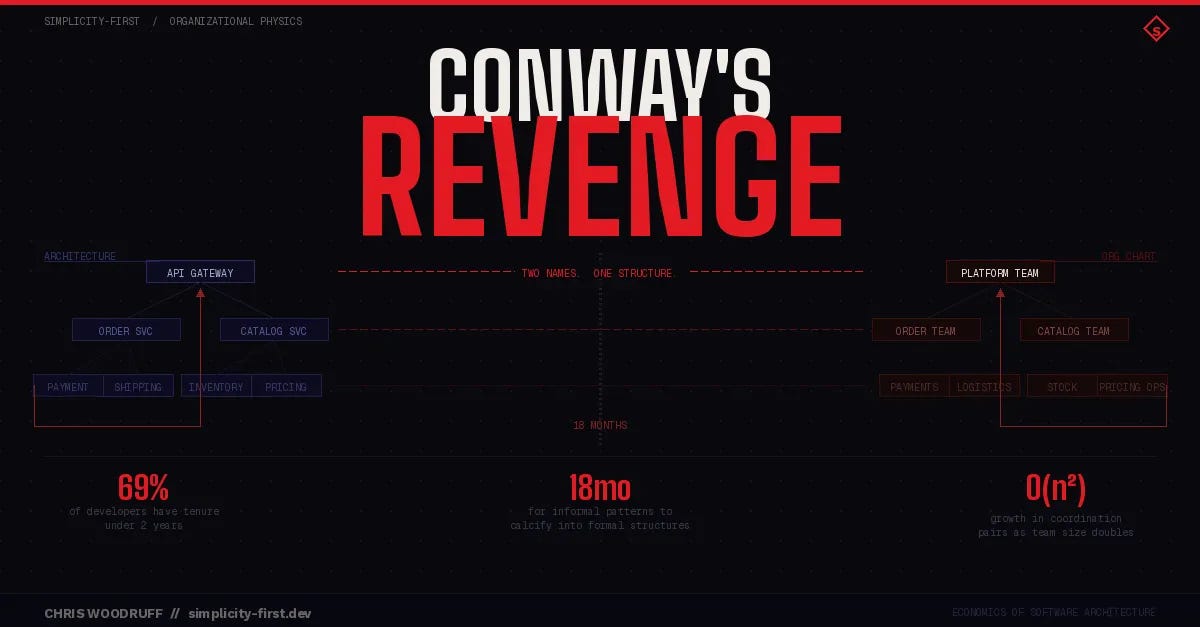
The architecture was simplified. The org chart was not. So the org rebuilt what it needed.
This is the half of Conway’s Law nobody finishes. Everyone cites the forward direction: organizations produce systems that mirror their communication structures. Almost nobody discusses the reverse. Restructure the system without restructuring the teams, and the teams will rebuild the system they are organized to produce.
The eighteen-month figure is not arbitrary. It tracks two engineering tenure cycles. 69% of software developers have tenure of less than 2 years. Within eighteen months, the engineers who understand the consolidation will be gone. Their successors follow the communication patterns they inherited, not the diagram. The patterns win.
This is Conway’s Revenge: the org chart keeps writing code whether anyone is watching or not.
The full essay covers what simplification programs miss, why the reversion is so consistent, and what the Inverse Conway Maneuver actually requires from a CTO who wants the simplification to hold. It also adds a missing line item to the Total Cost of Architecture: the org design cost embedded in every service boundary.
The service boundary in your architecture diagram is a headcount requirement in your org chart. The two documents describe the same thing.
Read it on Simplicity-First Philosophy.
