


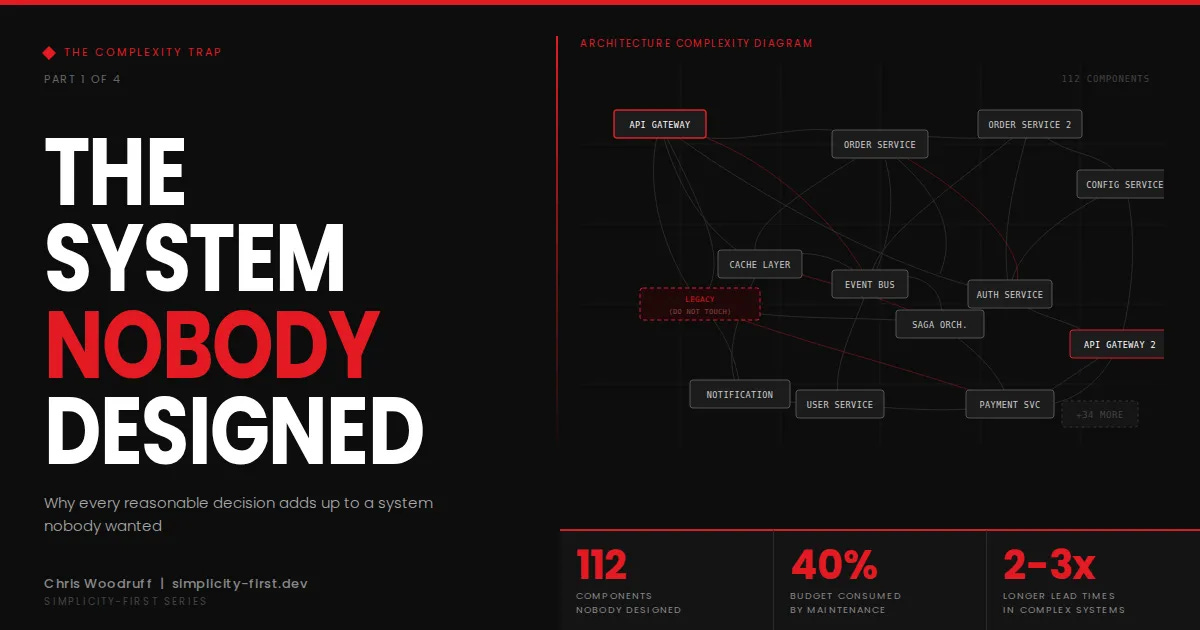
A new CTO joined an organization and asked for the system architecture.
Three days later, a PDF arrived. 112 boxes. 47 microservices. Two labeled “legacy (do not touch).” Lines crossing so many times, the diagram looked less like documentation and more like a subway map drawn by someone who had never ridden a subway.
She asked: Who designed this?
Nobody did.
Every box had a story. Every story made sense on the day someone added it. A cache for performance. A config service for flexibility. A second API gateway because migrating off the first one kept getting pushed to next quarter.
Reasonable decisions. Every one of them.
The collective result consumed 40% of the engineering budget on maintenance, shipped features in weeks that should take days, and produced 2-3x longer delivery times than simpler systems doing the same job.
This is the Complexity Trap. And it has three properties that make it so persistent: it is easy to enter, nearly invisible from inside, and it actively resists exit.
The new series starting today on the Simplicity-First Philosophy publication is about this trap. What it looks like from inside, why smart teams build it anyway, how to know you are in it, and how the Three Filters create a way out.
“The System Nobody Designed,” covers recognition. Five patterns that identify the trap. A diagnostic you can run on Monday morning. And the ego-protecting reframe that makes the conversation with leadership possible.
If the 112-box diagram sounds familiar, this series is for you.
